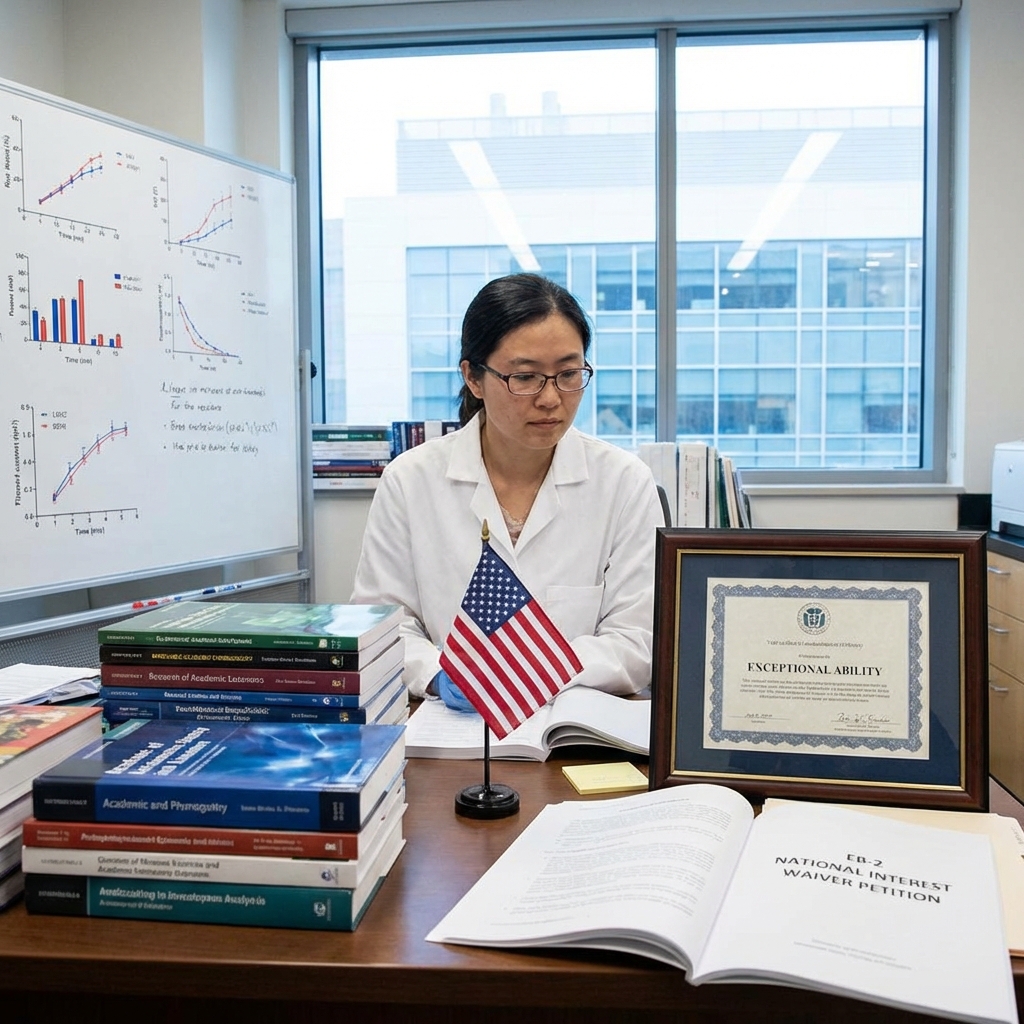
The National Interest Waiver allows exceptional individuals to self-petition for a green card without employer sponsorship. The key is demonstrating your work benefits the United States.
Key Takeaways
- No employer sponsor or labor certification required
- Must meet the three-prong Dhanasar test
- Evidence of national scope and impact is essential
- Self-petition gives you control of the process
The Dhanasar Framework
USCIS evaluates NIW petitions under Matter of Dhanasar:
- The proposed endeavor has substantial merit and national importance
- You are well positioned to advance the endeavor
- It would benefit the US to waive the job offer requirement
Building Your Evidence
- Publications and citations
- Letters from independent experts
- Evidence of impact on the field
- Grants, awards, media coverage
- Future plans and potential contributions
The Dhanasar Framework: A Deep Dive
Since 2016, NIW cases are adjudicated under the Matter of Dhanasar precedent. Understanding its three prongs is essential:
- Substantial Merit and National Importance: Your work must matter. "Merit" is usually easy (e.g., Medicine, Engineering). "National Importance" is the hurdle. It's not enough to benefit your employer; you must show broader impact (e.g., improving US healthcare outcomes, enhancing military technology, securing the US supply chain).
- Well-Positioned to Advance the Endeavor: This focus is on you. Do you have the education, record of success, progress in the field, and a plan? A PhD helps but isn't mandatory. A Master's + 5 years of progressive experience is the baseline.
- Beneficial to Waive the Job Offer: You must prove that on balance, it benefits the US to skip the PERM labor certification. Arguments often focus on the urgency of the work or the fact that your unique skills cannot be captured in a standard labor market test.
Premium Processing: A Game Changer
Historically, NIW cases took 9-18 months. Now, USCIS accepts Premium Processing (Form I-907) for initial NIW filings. For a fee ($2,805), you get a decision in 45 business days. This allows for rapid planning, though it does not speed up the "Priority Date" wait for the green card itself.
Transitioning from F-1 to NIW
Many PhD and Masters students file for NIW while on F-1 student visas. Crucially, filing an I-140 is an "immigrant petition," which conflicts with the "non-immigrant intent" of the F-1 visa. While USCIS policy has softened recently regarding F-1 students filing PERM/I-140s, travel can become risky. Once you file an I-140, renewing your F-1 visa stamp at an embassy becomes very difficult.
Dhanasar Prong 1: Defining 'National Importance'
This is where 80% of NIWs fail. USCIS distinguishes between "Global/General Importance" and "Specific National Importance."
Example: "I am an amazing dentist who helps patients." (Denied - benefits only your specific patients).
Example: "I am developing a new dental implant protocol that reduces opioid usage in post-op recovery, addressing the national opioid crisis." (Approved - broader systemic impact).
Your petition must focus on the *impact* of the work, not just your *competence* at the job.
Prong 3: Waiving the Labor Certification
Why should we skip the test of the US labor market? Arguments include:
- Urgency: The US needs this technology NOW (e.g., AI safety, Vaccine research).
- Nature of Work: The applicant is an entrepreneur creating jobs, so it makes no sense to have them "employed" by someone else.
- Past Record: The applicant's unique mix of skills is so rare that a standard job posting couldn't capture it.
Don't Risk Your Immigration Future—Get Professional Advice
Every case is unique, and small mistakes can lead to years of delays or denial. Don't rely on general online information. Schedule a consultation to discuss your specific situation with an experienced attorney who can protect your rights.
We offer a free 15-minute consultation to review your case.
Get Your Free Consultation NowDo I need a PhD for EB-2 NIW?
No. You need an "Advanced Degree" (Master's or higher) OR "Exceptional Ability." Many successful NIW applicants hold a Master's degree or a Bachelor's + 5 years of experience.
Does an NIW approval guarantee a Green Card?
It approves the underlying category. However, you still cannot file for the Green Card (I-485) until your "Priority Date" is current in the Visa Bulletin. For citizens of India and China, this wait can still be several years.
Disclaimer: This article is for general information only and is not legal advice. Every case is fact-specific. For legal advice, consult a licensed attorney.